Mathematics: still unknown. No accepted proof shows whether every smooth three-dimensional incompressible flow remains smooth for all time or whether a finite-time singularity can form.
Rumi’s philosophical answer: NO. The same form does not remain unchanged forever. It changes, dissolves and is renewed—while the underlying flow continues.
The Navier–Stokes equations describe how fluids such as water and air move. They work extraordinarily well in science and engineering. Yet in three dimensions, their deepest mathematical guarantee is missing: can a perfectly regular flow ever drive itself into infinite velocity or infinitely sharp variation in finite time?
u is velocity, p is pressure, ν is viscosity and f is an external force.
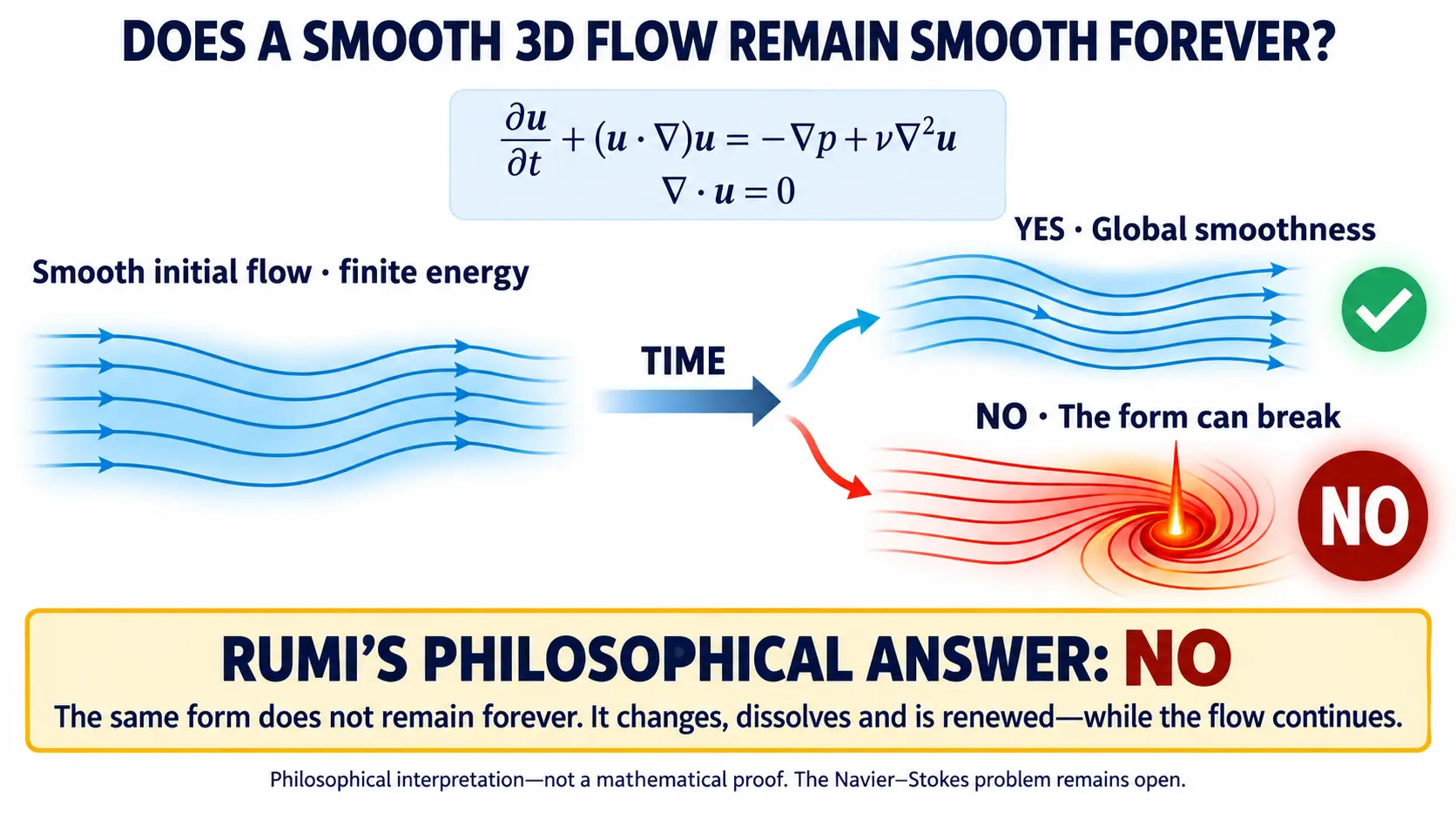
So, would Rumi answer yes or no?
No. Read through Rumi’s poetry, a smooth form would not remain identical forever. It would transform, dissolve and reappear through continual renewal. What persists is not the fixed shape of the wave, but the movement of the sea. This is the philosophical conclusion explored in this essay; the mathematical existence-and-smoothness question remains open.
What exactly is the Navier–Stokes existence and smoothness problem?
Begin with a three-dimensional velocity field that is smooth, has finite energy and is divergence-free—the mathematical statement that an incompressible fluid is not being created or destroyed inside the flow. The question is whether the Navier–Stokes equations necessarily produce a smooth velocity field for every later time.
A smooth solution has no points where velocity or its relevant derivatives become unbounded. If all admissible smooth initial data remain regular forever, that establishes global existence and smoothness. If even one admissible initial condition develops a genuine singularity in finite time, that establishes breakdown. Either rigorous result would resolve the official problem.
Two dimensions
The corresponding global regularity problem is understood much better and smooth solutions are known in the relevant setting.
Short times and small data
In three dimensions, smooth solutions are known locally in time, and global results exist under additional smallness conditions.
Weak solutions
Leray showed that global weak solutions exist, but weak solutions may lack the smoothness and uniqueness demanded by the prize problem.
Arbitrary smooth 3D data
No proof yet covers every allowed initial flow for all time, and no accepted finite-time blow-up example is known.
Is the Navier–Stokes problem solved?
No—not in the accepted mathematical sense. As of 11 September 2026, the Clay Mathematics Institute lists Navier–Stokes as an active Millennium Prize Problem. New claims may attract attention, but a claim is not the same as a recognized solution. Under Clay’s official rules, a proposed solution must appear in a qualifying publication, remain published for at least two years, and gain general acceptance in the global mathematics community before Clay will consider it.
This distinction matters for searches such as “Has Navier–Stokes been solved?” A numerical simulation, a special-case solution, a physical argument or an unreviewed manuscript may be valuable without resolving the precise theorem stated by Clay.
Why is the 3D equation so difficult?
The tension lies between two parts of the equation. Viscosity, represented by ν∇²u, smooths the flow by diffusing sharp variations. The nonlinear term (u·∇)u lets the flow transport and reshape its own velocity. In three dimensions, vortex stretching can transfer activity toward smaller scales. The unresolved task is to prove that dissipation always controls this nonlinear concentration—or show that sometimes it does not.
Computers can calculate immensely complicated flows, but no finite collection of simulations proves what happens for every admissible initial condition and for all future time. The gap is between seeing many waves and proving a statement about the entire sea.
Rumi’s first clue: continuity may be perpetual renewal
هر نفس نو میشود دنیا و ما
بیخبر از نو شدن اندر بقاعمر همچون جوی نو نو میرسد
مستمری مینماید در جسدAt every breath, the world and we are made anew,
Rumi, Masnavi, Book I, section 62 · literal rendering by the author
unaware of this renewing within what we call permanence.
Life arrives ever new, like water in a stream,
yet appears continuous within the body.
Rumi’s stream appears continuous precisely because it is never static. This is a useful philosophical companion to mathematical smoothness. The Navier–Stokes question is not whether a fluid changes; change is built into the equation. It asks whether change can remain coherently describable without a mathematical rupture.
In this reading, smoothness does not mean stillness. It means that continual transformation retains enough order to remain finite and differentiable.
The water is both moved and moving
آب را آبیست کو میراندش
روح را روحیست کو میخواندشThe water has a water that drives it;
Rumi, Masnavi, Book III, verse text · literal rendering by the author
the spirit has a Spirit that calls it.
The nonlinear term (u·∇)u means, roughly, that the velocity field carries itself through space. Rumi’s verse is not a scientific description of self-advection, but it gives us a striking conceptual image: the water is not merely a passive object pushed along a fixed road. Its motion helps determine the road ahead.
The flow is both the traveler and the road.
We see the foam; the proof must see the sea
چشم دریا دیگر است و کف دگر
کف بهل وز دیدهٔ دریا نگرجنبش کفها ز دریا روز و شب
کف همیبینی و دریا نی، عجبThe eye of the sea is other than the foam;
Rumi, Masnavi, Book III, verses 1271–1272 · literal rendering by the author
leave the foam and look with the sea’s own eye.
Day and night, the foam is moved by the sea;
strange—you see the foam, but not the sea.
Individual solutions, laboratory observations and simulations are the foam: real, informative and often beautiful. The theorem asks for the sea—a global statement covering an infinite family of possible flows. No number of sampled cases alone can cross that logical distance.
Rumi’s image does not supply the missing estimate. It clarifies why the missing proof is of a different order from successful computation: it must control the whole possibility space, not merely inspect its visible surface.
If a singularity forms, what actually “breaks”?
از سخن صورت بزاد و باز مرد
موج خود را باز اندر بحر بردصورت از بیصورتی آمد برون
باز شد که اِنّا اِلَیهِ راجِعونFrom speech a form was born, then died again;
Rumi, Masnavi, Book I, section 62 · literal rendering by the author
the wave carried itself back into the sea.
Form emerged from formlessness,
then returned: truly, to Him we return.
A Navier–Stokes singularity would not mean that water ceases to exist. It would mean that the classical smooth mathematical description can no longer continue in the required way—because some relevant quantity becomes unbounded as a finite time is approached.
Rumi repeatedly distinguishes the sea from the temporary form of a wave. In that language, perhaps the form breaks, not the sea. This is not an answer to the theorem, but it opens a serious philosophy-of-science question: would blow-up reveal a failure inside nature, or a boundary of the mathematical form by which we represent nature?
Black and white: smoothness and singularity
پس نهانیها به ضد پیدا شود
چونک حق را نیست ضد، پنهان بودHidden things become visible through their opposites;
Rumi, Masnavi, Book I, section 62 · literal rendering by the author
because the Real has no opposite, it remains hidden.
Smoothness
Order, continuity and a flow whose mathematical form remains finite.
Singularity
Blow-up, the unknown and the collapse of a classically describable form.
The sea
The underlying reality from which both mathematical possibilities arise.
In Black & White Universe, smoothness and singularity can be read as opposite answers—white and black. Rumi, however, treats opposites as instruments of perception rather than ultimate reality. They allow hidden structure to appear. The sea from which both possibilities emerge may be neither white nor black; those are the forms through which the mind divides the question.
The equation is a shadow of reality
سخن، سایهٔ حقیقت است و فرع حقیقت.
Speech is the shadow of truth and a branch of truth.
Rumi, Fihi Ma Fihi, discourse I · literal rendering by the author
An equation, too, is a kind of speech: exceptionally precise language that captures a structured shadow of nature. Calling it a shadow does not diminish it. The power of mathematics comes from the fidelity and consequences of that shadow. But the model and reality are not identical. If a classical description reaches a singularity, nature has not necessarily fallen silent; a particular language may have reached its boundary.
If Rumi answered the question
A CONTEMPORARY RESPONSE INSPIRED BY RUMI — NOT A RUMI QUOTATION
You ask whether water stays smooth forever,
or one day breaks inside its turning.
The water does not break; its shape breaks.
The wave is not lost; its name is lost.
You seek continuity in a fixed form,
while continuity lives in being renewed.
You see the foam become unbounded and fear it;
for once, look with the eye of the sea.
Navier–Stokes asks whether the form of a flow can remain smooth forever. Rumi suggests that true continuity is not the permanence of form, but its ceaseless renewal.
What science must still prove
Rumi’s answer is ontological; the Millennium Prize Problem demands a theorem. A complete solution must meet the precise alternatives in the official problem description by Charles Fefferman: prove that the stated three-dimensional equations always possess globally smooth solutions for admissible smooth initial data, or rigorously demonstrate a breakdown scenario allowed by the statement.
Poetry can sharpen the question. It cannot replace the estimates, inequalities and logical closure of a proof. The most honest meeting between Rumi and Navier–Stokes therefore preserves both truths: mathematics tells us exactly what remains unknown; poetry helps us understand why flow, form and continuity matter beyond the equation.
Frequently asked questions
- What is still unsolved about the Navier–Stokes equation?
- For smooth incompressible flow in three dimensions, no one has proved that a smooth solution must exist for all future time, and no accepted example proves that such a solution develops a finite-time singularity.
- Is the Navier–Stokes problem solved in 2026?
- No accepted solution is recognized by the Clay Mathematics Institute. Clay listed the problem as “Active” on 11 September 2026.
- Do the Navier–Stokes equations work if the problem is unsolved?
- Yes. The equations are used successfully throughout fluid mechanics. The open problem concerns a universal mathematical guarantee for a particular class of three-dimensional solutions, not whether engineers can use the equations.
- Is turbulence the same as the unsolved problem?
- No. Turbulence motivates and complicates the subject, but the Clay problem is specifically about existence and smoothness—or breakdown—of solutions under its formal assumptions.
- What would a Navier–Stokes singularity mean?
- It would mean that a classical smooth solution cannot be continued because a mathematically relevant quantity becomes unbounded as a finite time is approached. It does not mean that physical water disappears.
- Why can’t computer simulations prove smoothness?
- A simulation samples finite resolution, finite time and particular initial data. The theorem must cover every admissible smooth initial condition and all future time, including scales a finite computation cannot exhaust.
- Would Rumi answer yes or no?
- No. In this philosophical reading, the same smooth form does not remain unchanged forever; it changes and is renewed, while the underlying flow continues. This is not a mathematical proof.
- Did Rumi solve the Navier–Stokes equation?
- No. The connection is philosophical. Rumi’s images of streams, waves, foam, form and formlessness offer a vocabulary for contemplating the problem, but they are not mathematical evidence.
- Why is Rumi also called Molana or Mevlana?
- These are regional forms of an honorific meaning “our master.” English readers commonly know Jalal al-Din Muhammad Balkhi as Rumi; Persian speakers often call him Molana.
Primary references
- Clay Mathematics Institute: Navier–Stokes Equation
- Charles L. Fefferman: official Navier–Stokes problem description
- Clay Mathematics Institute: Millennium Prize rules
- Persian verse texts are linked directly from each bilingual quotation above.